skip to main |
skip to sidebar
 The crown jewel of Bogotáno transportation has to be the modern TransMilenio rapid transit system. In development since 2000, the system operates much like a train system on wheels with large articulated buses ferrying up to 160 passengers at a time between 116 elevated stations on nine lines - complete with express and local service. Special dedicated lanes, or troncales, were added to the middle of existing roads to accommodate the new system, presenting a low cost solution to this city's major congestion problem.
The experience goes something like this: Upon entering a station, passengers purchase smart cards loaded with fares for one or several trips on the system (1500 pesos per trip or about 65 cents.) After tapping your card to a sensor and passing through the turnstile, there are easy to read maps that outline the service provided at that station. Even for non-spanish speakers, the alpha-numeric route system is easy to decipher. Once you've determined what bus you need to take, overhead LED signs update you on the expected arrival time of your bus. Coming from Chicago, where communicating useful information to your paying customers is something that has not yet dawned on the transit authority, TransMilenio is an incredibly refreshing user-friendly system.
 The only problem TransMilenio is that it may be too good. About 1.3 million riders use the system each day and during rush hour you can expect buses on heavily used routes to be bursting at the seams. The crush of bodies is entirely bearable, however, when you realize you are whisking past gridlocked traffic at an incredible rate. Efficency has its price.
Perhaps the most remarkable feature of the system is its cost. According to the Transportation Research Board of the U.S. National Academy of Sciences, the seven phases of TransMilenio development will eventually cost $3.3 billion (USD) and cover almost 400 km of roadway. This number is ten percent LESS than a proposed 30 km subway line. Clearly, the Bus Rapid Transit (BRT) model, of which TransMilenio is the largest in the world, is an excellent low-cost transportation option for rapidly developing cities on a tight budget.
Just keep your hand on your wallet...
 December 1st is World AIDS Day. Those readers who know me are aware that before coming to Colombia I worked in HIV/AIDS advocacy in Chicago. Its an issue I am personally devoted to and hope to find a way to continue my involvement here in Bogotá.
In commemoration of the day, I thought I'd write up what I've learned so far about the epidemic here in Colombia. The World Health Organization (WHO) estimates that there are 170,000 living with HIV in Colombia. Of these, about 47,000 are women. This translates to a prevalence of about 0.6% in the general population.
Just as in the U.S., gay men and men who have sex with men bear the brunt of the epidemic. In 2002, the most recent year WHO numbers are available, an estimated 19.7% of men who have sex with men in major urban areas are living with HIV. Similar numbers across the globe recently led world leaders to declare at the 2008 International AIDS Conference in Mexico City that entrenched homophobia remains a primary obstacle towards truly effective HIV prevention programming for gay men.
Just as with gay men, the intersection of women and HIV in Colombia mirrors global trends. Lacking other economic opportunities, many women are forced into the sex industry where knowledge and use of protective measures, such as condoms, is far from universal. Furthermore, Colombia's decades-old internal conflict has led to countless instances of physical and sexual violence against women by the armed elements within the country. These factors combine to put many women, especially in rural areas and along the coast, at an increased risk of acquiring HIV.
One of the greatest success stories in the nearly 30 year battle against HIV/AIDS has been the development of highly effective means of preventing mother-to-child transmission of HIV. In Chicago, I was proud to work alongside the team that has all but eliminated instances of mother-to-child, or perinatal, transmission in the state of Illinois. Sadly, in Colombia these services are only available to an estimated 6% of HIV-positive mothers.
I have only begun to learn about the domestic HIV/AIDS situation here and my knowledge is indeed lacking. (For example, I have yet to learn anything about Colombia's injection-drug using population.) I hope to continue to uncover more and find a way to become actively involved in Colombia's fight against HIV/AIDS.
 I'm going to depart from the facts for a little commentary on two points related to Friday's march...
First, why was Betancourt leading the rally from Madrid?
Betancourt is rightfully seen as a hero in this country. Her endurance and survival have made her a powerful symbol of strength in the face of the violent elements that have held this country hostage for so long.
Betancourt is French-Colombian and after her release she returned to France to recover and reconnect with her family. That sounds like an excellent and appropriate idea. In fact, I wouldn't blame her for never wanting to return to Colombian again. However, she is a strong leader and realizes that she is in a unique position to lead the public in resisting FARC and the other armed actors in Colombia.
If she weren't planning on returning to the country, then leading the rally in Madrid makes complete sense. The French and Spanish in particular have stood by the Colombians in denouncing FARC and they are strong international partners on this issue.
However, Ingrid came back on Saturday. Why not return a day earlier and lead the marchers here? This is where the conflict is and, while cultivating European support is a worthwhile endeavor, at the end of the day change must come from withing Colombia. This is where the work must be done.
I assume there are serious security concerns that would prevent Betancourt from making such an open public appearance in Colombia. Regardless, I think from an organizing standpoint, public knowledge that she is here and unable to safely appear in public is a much more powerful draw for people to join in the protests. At the risk of sounding too harsh, a rally in Madrid is effectively an empty gesture and more of a photo-op than a real political organizing strategy. But you do get to kick it with the Spanish foreign minister.
Anyway, this is only the beginning of her leadership on this issue and I trust she knows what's she doing much better than I. I look forward to watching and reporting on her work here.
Second point, English language media coverage of Friday's protests.
 Nearly all the English language coverage of the marches framed them as solely anti-FARC in nature. As someone who was here on the ground I have to say that this is a pretty egregious misrepresentation of reality. Now, I'm not a reporter nor am I an expert on the internal conflict here in Colombia, however any person who has decent eyesight and a basic understanding of Spanish could see that, while the majority of signage and slogans were anti-FARC, there was a very noticeable contingent of people protesting other guerilla groups, paramilitary groups, and ongoing human rights abuses by the Colombian military.
I'm told many people here use the term FARC to mean guerrillas in general and anti-FARC could be broadly understood to mean anti-guerrilla. However, focusing only on guerrillas means you are gravely oversimplifying the nature of this conflict. Framing the conflict in this way amounts to nothing less than poor journalism.
I think the best frame I've been exposed to is this: the conflict can be best characterized as armed actors (i.e. guerrillas, paramilitaries, and government security forces) assaulting the peace and human rights of the civilian population. In other words, its the guys with guns against everybody else. Who's 'side' the are on is largely irrelvant. All sides have been linked to hundreds of instances of murder, kidnapping, and other atrocities.
For some good background on the armed actors, check out this report by Amnesty International.
 Yesterday, thousands of Colombians across this country and the globe took to the streets to protest the ongoing kidnapping, violence and other atrocities being committed by the armed elements of within the country. Clad in white t-shirts declaring 'Colombia Soy Yo' (I am Colombia), protesters most notably directed their ire towards Las Fuerzas Armadas Revolucionarias de Colombia (FARC) which holds an estimated 750 individuals in captivity.
However, its important to note that protesters also carried signs denouncing other guerrilla groups such as the Ejército de Liberación Nacional (ELN), paramilitary groups such as the Autodefensas Unidas de Colombia (AUC), and human rights abuses carried out by the National Army - reflecting the complex nature of the internal conflict.
In Bogotá, Carrera 7 was shut down for much of the afternoon as protesters march along its length. Many held photographs of family members who have been kidnapped or otherwise victimized in Colombia's decades-old internal conflict. This is the third march of this kind in 2008.
A rally in Madrid was led by former FARC captive and former Colombian presidential candidate Ingrid Betancourt, who was freed in a daring resuce operation several months ago. Word also came this morning that Betancourt will return to Colombia tonight for the first time since she was freed from capitivity.
Gringo media coverage:
BBC News
Associated Press
Ed. Note: This is the first mention I've made on Colombia's internal conflict. In the near future I will put together a post with a brief history and current status of the conflict.
 If buses are the lead in the dangerous dance of Bogotáno traffic, their more graceful and agile partners are certainly the many tiny taxis jamming the streets. While the buses dominate the road way, the cabs are capable of weaving in and out of the way of their larger companions by utilizing some of the most spectacular death-defying maneuvers. These guys have to be some of the best drivers on Earth.
The cabs here are plentiful and, in my experience, relatively cheap. You can get halfway across the city for about ten thousand pesos (or a little less than $5 USD). Thanks to the numbered streets, its pretty easy to communicate where you want to go even if your Spanish, like mine, is poor.
Just like buses, the density of cabs makes them pretty easy to grab on any street corner. However, one of the nicest features of the cab companies here are their automated phone ordering systems. They have easy to remember phone numbers like 1-222222 or 1-444444. Even easier for the foreign visitor is the fact that you don't have to speak to anyone if you are calling from a land line. Just acknowledge you want a cab and they send it to the address associated with the phone number.
Once you climb into your cab and give the driver your destination, you'll notice one major difference from cabs in the U.S.: the size. Happily, the entire fleet of cabs in Bogotá (and cars in general - another post!) is made up of small, fuel-efficient vehicles. This is a big contrast from the full-size, gas guzzling Ford Crown Vics that are the standard in the U.S. While the extra leg room is nice, the recent rise in the price of gasoline has been devastating for cab drivers in Chicago and around the U.S. further driving up the cost of cabs via government imposed fuel surcharges. This is much less of an issue here.
Once the cab starts rolling down the calle, the thrill ride begins. I recommend not paying attention to some of the moves your driver will pull, ignorance is indeed bliss. In a city where the lanes painted on the road seemed to be considered wholly decorative, cab drivers are the masters of squeezing through any hole, cutting off any bus, and making turns onto any street from any lane (amazing!)
 After dark, red lights are optional and more often than not you'll find your driver disregarding them completely. I'm told this is legally sanctioned to help avoid robberies but it takes some getting used to.
Not only do drivers engage in this truly impressive behavior, but many of them embrace it. I've been in more than one cab that is suped up like a rally-car, complete with racing-style gauges and steering wheels. Incredible.
After my first few rides, I've left fear in my rear-view mirror and have come to really enjoy and respect the skills of these drivers.
 Thanksgiving is my favorite holiday. It is delightfully unfettered by divisive religious, material, or patriotic considerations and instead focuses solely on the commonly held important things in life: family, food, and football. Much to my surprise, I was able to score a turkey and a pan big enough to roast it in yesterday and was able to pull off a modest but satisfying turkey day meal with a few close friends.
While our deepest associations with this holiday have to do with quality family time, eating too much, and being trapped in airports or on the highway, my passing of the day outside of the United States has caused me to reflect on the historical foundations of the day and its place in the U.S. national identity, which in turn lead me to more questions to ask as I seek greater understanding of Colombia.
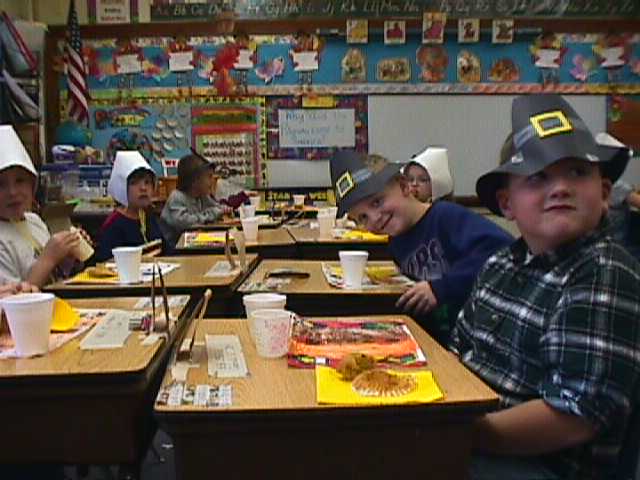
 Anyone who has passed through grade school in the U.S. has had the experience of fashioning crude Pilgrim and Native American headgear out of construction paper (that most versatile of media) and re-enacting the First Thanksgiving. A warm and cozy display of inter-cultural harmony and brotherhood celebrating a successful harvest and survival in the New World.
What's left out of these adorable stagings is any recounting of the hundreds of Thanksgivings that followed that first one at Plymouth Plantation. The next few hundred years were marked by the near total destruction of Native American culture in North America through violence, persecution, disease, and aggressive expansionism by European settlers. Its an area we more often than not leave out of our national story and would just as soon like to forget (as evidenced by putting Andrew Jackson on the twenty dollar bill.)
Now I'm not trying to get up on a soapbox and preach about what we all know to be clearly recorded history. What spending Thanksgiving in Colombia made me think of is what I perceive to be the vastly different historical experiences of the indigenous people of Latin America versus Anglo America.
There is one statistic in particular that outlines this question with crystal clear relief. In Colombia, about 82% of the population is of mixed Amerindian and European ancestry and another 3.4% is of fully indigenous heritage. In the United States, those numbers are 0.9% and 0.74% respectively. The map below shows the level of indigenous population in the Americas. A full breakdown of these numbers for the Americas complete with sources can be found here.

Now, this difference is of course news to no one. However, this blog is about my journey towards deeper understanding of Colombian culture. Learning about the influence of both historic and contemporary indigenous populations on this country's culture is a vital part of that journey. Furthermore, I believe a comparative approach that explores the differences between Latin American versus Anglo American experiences with their respective indigenous populations will serve to greatly enrich the discussion. As such, I am officially adding this to the list of areas in which I want to cultivate deeper understanding via this blog.
Is there an anthropologist in the house? If anyone reading has any insight or resources to share, please leave a comment!
 For my first installment on getting around Bogotá, I've decided to tackle the most frequently used (and most fearsome) mode of transportation: the bus. In my opinion, this absolutely has to be number one on the 'things-that-are-different-about-Bogotá' list.
The bus system consists entirely of privately owned and operated buses. These machines come in every conceivable make and model, from modern to medieval, but all have one thing in common: heavy diesel exhaust. For me, this is probably one of the things I noticed first about the city. Every busy street is consumed by a cloud of particulate matter (look no further than the inside of your nose for proof).
During the day, major thoroughfares are clogged with, in my estimation, 50-75% bus traffic. To the novice rider, such as myself, the chaos is daunting (I've only recently worked up the courage to ride the buses on my own).
In addition to the sheer volume, knowing which bus to take is equally overwhelming. The routes are indicated on nearly imperceptible signs placed in the windshield. While I'm told some numbering system for these routes exists, I have yet to meet a local who can explain it to me. Instead, one must rely on the street names and neighborhoods listed on the signs.
All of this takes place in the context of no actual bus stops. Potential passengers must take it upon themselves to locate the proper bus and simultaneously attract the attention of the driver. Didn't get their attention? No worries, another bus will be along in about five seconds. This is where the density and organic nature of the system is at its best. During peak hours, it seems a seasoned rider can catch a bus from anywhere to anywhere in less than five minutes.
Ok so you've located the right bus and flagged it down. Here comes the fun part:
 Stepping on-board you are confronted with your first obstacle, a turnstile (what you thought you could just walk on??) Before you have time to pass through, and while the door is still open behind you (they never close), the driver hits the gas and starts shifting gears (all the buses are manual transmission). Hold on tight because I've heard people have been tossed off and even killed by the combination of open doors and grinding gears. But hey, if the driver can shift gears, make change for your fare, and keep an eye out for more passengers all at the same time...you should be able to pay and go through the turnstile without falling out onto the street. If multi-tasking isn't your thing, take a cab.
If you happen to be on a bus with an open seat, good luck if you are over six feet tall. The seats are cramped to say the least.
Once you are settled, its time for the on-board entertainment. On the bus I rode yesterday, I was entertained by a women selling incense, a man selling colored pencils, and two clowns - each with a well rehearsed, non-stop monolouge (that I guess was funny since I couldn't understand what was said but everyone was laughing).
As noted above, there are virtually no bus stops. So when its time to go, you just have to hit the stop button and the driver will let you off whereever you want.
All of this for about 60-70 cents.
While the private system has its perks in terms of convience, the jobs it provides, and its colorful character, I have to say I prefer the publicly owned and operated bus system I left behind in Chicago - if only for the lame reasons of saftey and pollution control.
I've asked some friends about this and apparently policy makers in Bogotá feel the same. However, the bus operators are extremly well organized and capable of holding the city hostage by striking and blocking the streets. I am told this is the biggest obstacle towards reforming the system.
So for now, get your pesos ready and hold on tight.
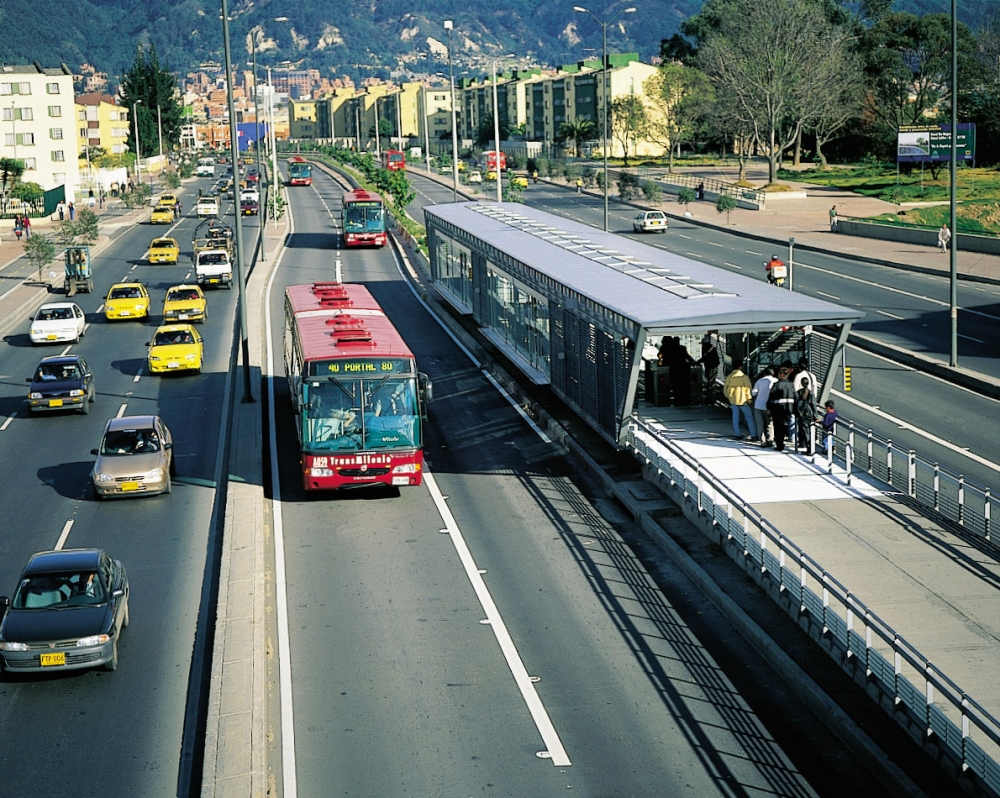 The crown jewel of Bogotáno transportation has to be the modern TransMilenio rapid transit system. In development since 2000, the system operates much like a train system on wheels with large articulated buses ferrying up to 160 passengers at a time between 116 elevated stations on nine lines - complete with express and local service. Special dedicated lanes, or troncales, were added to the middle of existing roads to accommodate the new system, presenting a low cost solution to this city's major congestion problem.
 The only problem TransMilenio is that it may be too good. About 1.3 million riders use the system each day and during rush hour you can expect buses on heavily used routes to be bursting at the seams. The crush of bodies is entirely bearable, however, when you realize you are whisking past gridlocked traffic at an incredible rate. Efficency has its price.