The New York Times sits down with David Murcia Guzmán, former CEO of the now defunct Colombian pyramid operation DMG.
A bit of context: The collapse of the DMG scheme effected hundreds of thousands of Colombian families. It was a huge financial scandal. The biggest twist in the tale is that many former DMG customers resent not the bogus operation but the Colombian government for shutting it down. Protests in support of Guzmán and DMG have been a common site here in the capital and, for the first time, President Alvaro Uribe has had to pay a dear political price in the public eye.
Check it out.
Monday, February 2, 2009

Monday, January 26, 2009
Evil Bananas

Besides containing the death place of El Libertador, Simon Bolivar, Santa Marta and the department of Magdalena have played host to other, more sinister moments in history. And indeed, the big cargo ships from the Dole Food Company I saw in the Port of Santa Marta carry more than bananas, they also bear the tragic legacy of worker exploitation and an internal conflict often fueled by the narrow interests of foreign corporations.
No where is this intricate connection better exemplified than in the sad tale of the United Fruit Company and what has become known as the Banana Massacre of 1928, which took place not far from Santa Marta. While the complete truth is lost to history, it is known that in 1928 workers on United Fruit Company's banana plantations outside of Santa Marta went on strike seeking better pay and working conditions. Eventually it grew into the largest labor demonstration yet seen in Colombia.
What happened next remains hotly debated. Government troops opened fire on the demonstrators and killed an untold number of them. Estimates range from 50 to more than 2,000 dead.
Some historians maintain that the troops were dispatched at the urging of the U.S. Embassy in Bogotá in order to protect United Fruit Company interests in the area. And indeed, the Wikipedia page on the incident documents a series of chilling telegrams between Washington and diplomats in Colombia during the ordeal.
It remains a bitter memory in the collective conscious of Colombia and was immortalized by the country's own Nobel Laureate, Gabriel Garcia Marquez, in his novel 100 Years of Solitude.
 One would hope that 80 years later such an insidious intersection of commercial interest and political violence would be a distant memory. However, the United Fruit Company, now known by the more family friendly Chiquita brand (with that pretty lady with the fruit on her head), has been accused of, and indeed plead guilty to, funding the United Self-Defense Forces of Colombia (AUC), a right-wing paramilitary group listed as a terrorist organization by the U.S. government and guilty of countless atrocities in Colombia.
Now, Chiquita had to cough up $25 million USD last year to the U.S. Department of Justice due to these activities. But for a company that has an estimated annual revenue of about $4 billion USD, that's pretty small bananas.
Any hope that the executives of the company, who were fully aware of the activities, will be extradited to Colombia to face criminal charges is...uh...a long shot to say the least.
Here's a tip. If you want to avoid facing justice for the human rights violations committed by your multi-national corporation, like former Chiquita CEO and person-who-gives-white-guys-a-bad-name Carl Lindner, Jr., it helps to be a top Republican party donor. Dropping $250,000 on George W. Bush's second inaguaration ain't bad either.
Apologies to anyone not able to enjoy a banana ever again. Don't blame the fruit, its not it's fault its delicious.
Wandering Gringo: Santa Marta from Tayrona to Taganga
 I wrote below that the road to Santa Marta was not without its challenges, however, eventually we reached our destination. Santa Marta rests between the mountains of the Sierra Nevada de Santa Marta and the Caribbean Sea. For the last five hundred years, the city has served Colombia both as an important port and as the capital of the department of Magdalena.
Home to just over 400,000 people, Santa Marta is one of Colombia's top destinations for fun-in-the-sun thanks to its warm climate, sunny beaches, and access to the natural magnificence of Tayrona National Park.
For tourists, there are two sides of the city to be experienced. El Rodadero (pictured above) is the modern, hyper-developed tourist center full of gringos, hotels, restaurants, and a stunning beach. However, if you are in the mood for more of a Spanish colonial vibe, the historic district of Santa Marta proper is currently experiencing a surge of redevelopment.
One need look no further than the port of Santa Marta to see why. What once was serving primarily as a point of export for bananas, coal, and other goodies from the interior is now also serving as a point of disembarkation for sun-burned, gringo tourists on large, modern cruise ships. Great for the local economy, which can use all the jobs it can get to tackle its serious poverty issues, but bad for the authentic feel. But hey, small price to pay for some much needed economic development, right?
 In my opinion, the five hundred year old coastal city is beaten, hands down, by the ageless natural splendor of the Tayrona National Park (above). One of the most important nature preserves in the country with the second most biodiversity in the world. Tayrona is simply awesome.
There are a number of trails that lead you through dense rain forest out to the sea. If you don't want to walk, you can ride a donkey, which coincidentally is how they get all the beer out to the several low-key seaside restaurants that occupy a few of the beaches - an acceptable intrusion on the pristine scenery.
Once there you can camp out in a tent, cabin, or just a hammock. Not bad.
 After two days of checking out the beaches in Tayrona, we headed to a small fishing village just outside the city, Taganga (right). While tourism appears to be the largest business nowadays, there are still plenty of fishing boats and nets dotting the beach - proof that there's still something worth catching out there (likely to feed hungry tourists.)
From the village you can hop on a boat for a ten minute ride to one of several nearby, secluded beaches. A great place to pass the day snorkeling, swimming, sunbathing, eating fresh fish, and drinking cerveza. Since we were there just after Christmas, one of the high seasons for tourism, it was a bit crowded, but still beats the Jersey Shore boardwalks.
In addition to its coastal attributes, Santa Marta is also famous as the death-place of Simon Bolivar, the much-revered Latin American liberator. La Quinta de San Pedro, the estate where he past in the 1830s, has been well maintained and is a great destination for history buffs.
Friday, January 23, 2009
Obama Baby in Cali
In Cali, on the Colombia Pacific coast, another positive reaction to Obama's ascendency to the Casa Blanca.
Thursday, January 22, 2009
Natural Gas Vehicles, Part II
 So at the end of my post on natural gas vehicles I asked the question, 'if there is a cheaper, cleaner source of fuel here - why all the dirty buses?' Needless to say, I've been bugging many of my Colombian friends about it as well. Well, word got round to a chemical engineer and I got some more information to share.
One specific question I had involved why Transmilenio wasn't developed with natural gas powered buses as the foundation. Her reply was that natural gas does not work as well for large vehicles for the same reasons that they use diesel instead of gasoline (that is higher energy per unit of volume, more torque, greater efficiency.)
So natural gas powered buses are not a feasible alternative and neither are expensive and short-lived exhaust filters, then what?
Apparently the easiest and most effective reform would involve eliminating low-grade diesel from Colombia's fuel inventory. Diesel fuel in Colombia contains 10 to 100 times more sulfur than the diesel used in the U.S. and Europe, known as 'Ultra-Low Sulfur Diesel (ULSD).' Sulfur acts as the nucleus for particulate matter, attracting other pollutants to form big gross balls of nastiness.
Wow! That seems like a straight-forward and achievable policy goal. Undoubtedly, ULSD is likely much more expensive than the dirty stuff. However, if you frame the analysis in terms of cost-savings via chronic disease prevention I would guess that it's a pretty good deal and worthy of government subsidy. Especially here, high in the Andes, particulate matter can cause all kinds of public health problems.
I'm not sure if an analysis has been done on this or not. But I'm going to find out!
People are happy here too...
 Yesterday, I was on my way to sign-up for Spanish classes at the National University here. I was stopped by security on my way through the gate because they wanted to check the serial number on my laptop and give me a pass. When they asked for my name, drawing on my experience, I decided to show my ID instead of trying to pronounce my name.
"Soy un gringo," I said with pride.
"Obama!" one of the guards responded.
"Lo maximo! Estoy muy feliz," I replied (The best! I'm very happy!).
"Yo tambien," agreed another guard.
Secretary of State Clinton on Colombia

The United States' new top-diplomat discusses U.S.-Colombian relations during her confirmation hearing with the Senate Foreign Relations Committee.
Semana with the coverage.
Friday, January 16, 2009
Natural Gas Powered Vehicles

Why do some cabs have gas cylinders in the trunk?
Initially, I was disappointed to learn that they aren't due to some underground, Fast and Furious, nitrous-boosted taxi cab racing scene - where the stakes are high and the fares are even higher. The reality is much more pedestrian, but interesting nonetheless.
According to the numbers I've seen around the web, Colombia has between 200,000 and 250,000 vehicles that run on compressed natural gas (CNG). These vehicles are served by just over 300 CNG filling stations around the country.
Natural gas has several advantages over gasoline as a motor vehicle fuel. While still emitting the chief global warming culprit carbon dioxide, natural gas burns much cleaner than gasoline or diesel. This characteristic is particularly attractive in higher altitude cities like Bogotá where, as I've mentioned, particulate matter can be a real public health problem.
In addition to the environmental benefits, natural gas is also less expensive per unit of energy than gasoline. In Colombia, this is largely due to the four trillion cubic meters of natural gas reserves the country contains - a decent domestic supply. All of these benefits can be attained by a relatively low-cost conversion of a regular gas engine. Pretty cool.
A lot of other countries also have well developed systems to take advantage of their natural gas reserves. In South America, Argentina and Brazil have a few million CNG powered vehicles in their respective fleets - as do countries in other parts of the world, like Italy.
What I would like to know is this: if there is a cheaper, cleaner alternative to gasoline and diesel fuel, why all the dirty buses?
Tuesday, January 13, 2009
Wandering Gringo: The Road to Santa Marta
View Larger Map
While I was away from Bogotá and the blog, I had the happy opportunity to hit the road and drive from Bucaramanga to Santa Marta on the Atlantic coast on Colombia's Highway 45.
Not unlike the ride from Bogotá, the going is slow, however, this time I was able to sit back and admire the scenic Colombian country side. Heading North out of Bucaramanga, I was struck at how quickly the urban landscape gave way to pure, cattle spotted countryside. The terrain immediately outside of the city is still mountainous, providing a roller-coaster like ride zipping from vista to vista of small farms nestled in the steep valleys.
After about an hour and a half, you come down out of the cordillera onto a seemingly endless plan. The altitude change is made inescapably clear by the big jump in the temperature from about 75 to 90 degrees Fahrenheit.
Initially, the land appeared to be mostly used for grazing cattle, however, as we proceeded further North into the department of Cesar, we entered a large oil palm plantation. I'm told there are tens of thousands of hectares of oil palm being grown in this region. Colombia is the fifth largest producer of palm oil in the world and the department of Cesar is the number two palm oil producing department in the country.
Indeed, oil palm is being touted by the government as a sustainable alternative to coca cultivation - one that could even be used to produce biofuels. However, several human rights organizations have said this economic lure has led paramilitary groups and businesses to displace and/or prevent the return of people living on potentially productive palm oil land in the Northwest section of the country (see BBC report on this issue.)
Shortly after passing through the palm plantation, I encountered another unfortunate obstacle to swift passage along the highway: el trancón or traffic jam. This particular traffic jam was caused by a group of motorcyclists who were holding up traffic as a means of protesting the recent traffic related deaths of two fellow cyclists (the police we spoke to said they were drunk at the time).
Trucks and vacationers headed to and from the coast were backed up for a dozen or more kilometers in each direction.

We were stopped for more than two hours, but luckily we had beer.

And others had hammocks.

In addition to agribusiness and moto-protests, we passed through a dozen or more small towns. Unlike the highways in the U.S. that bypass every town, Highway 45 in Colombia passes right through the middle of each town, forcing drivers to slow down with speed bumps. And at every speed bump, there is someone looking to sell you something - fried pork skin, bottled water, ice cream.
Indeed, in many of these towns the economic outlook is very bleak and the holiday traffic provides a much needed source of income. Cinder-block houses with dirt floors and thatched roofs were a common sight. A far cry from the modern shopping malls filled with luxury goods on the north side of Bogotá.
Monolingual Survival Guide
 Here's the first installment of what I hope will be an ongoing collaboration with the English-speaking Colombia dweller's best friend: Colombia Reports.
Check it out.
Monday, January 12, 2009
One for the road...
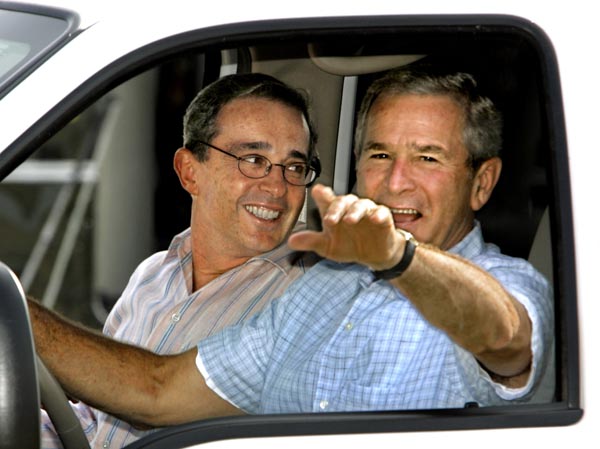 Some human rights groups are not too happy about Bush awarding Colombian President Alvaro Uribe the United States highest civilian honor, the Medal of Freedom. Bush thinks Uribe's doin' a heckuva job fighting terrorists, that freedom hater Hugo Chavez, and those mean guys who made Bush do all that cocaine back at Yale (gratuitous Bush-bashing yes...but only eight days to go!)
Of course, to keen oberservers the integrity of the Medal of Freedom was long ago trounced upon by this administration. Look no further than fellow recipient George 'Slam Dunk' Tenet - former CIA director and key Iraq War intelligence fucker-upper.
Apologies for the slight deviation from the stated purpose of this blog...back to business.
Barriers to HIV Treatment in Colombia
Here's a good look at how Colombia's decentralized health care system impacts the provision of HIV/AIDS related care and treatment (thanks to Adriaan from Colombia Reports for sending this my way). Like many other places in the world, men who have sex with men and sex workers are among those at the highest risk for acquiring HIV in Colombia, however, the armed conflict shows its face in this arena too, with an increased prevalence among those who are displaced by violence.
Saturday, January 10, 2009
Making the Case
 The L.A. Times sits down with the Colombian Minister of Defense, Juan Manuel Santos, to talk about the future of Plan Colombia under an Obama administration facing a trillion dollar budget deficit.
But really, I doubt Plan Colombia is going anywhere. What's a few hundred mil awash in a trillion dollar ocean? Cynical interpretation: its a small price to pay for one of the only Latin American-related talking points the Mesopotamian-minded U.S. foreign-policy universe can churn out these days. I think a lot of U.S. pols are less worried about the dubious merits of the program than having something to talk about other than Cuba or Hugo Chavez.
Here's hoping the Obama administration will become more engaged and shake things up a bit. We'll see.
Wednesday, January 7, 2009
Wandering Gringo: Bucaramanga
View Larger Map
Like many other cities, Bogotá almost completely shuts down and empties out near the end of the calendar year. Business comes to a stand still and many people travel to spend the holidays with their families in other parts of the country. Not wanting to miss out on this experience, I was thrilled to be invited to spend a few weeks with my girlfriend's family in Bucaramanga, capital of the department of Santander, about 200 miles north of Bogotá.
Now getting from Bogotá to Bucaramanga isn't exactly like driving from Chicago to Indianapolis. Those accustomed to the high-speed effiency of the Eisnehower Interstate System of the U.S. may find the road system here a bit, shall we say, challenging. All told, it takes about 8 hours of winding your way down through the Andes to reach Bucaramanga from Bogotá. I took an overnight bus, which means trying to sleep while the hyper-aggressive operators try to take the corners like an Indycar driver. It was a surreal experience and I felt like someone who was sleep deprvied after hours of interrogation, ready to confess to anything. However, for $30 you really can't beat it.
 The insanity started to melt away as the sun began to rise and I got my first look at Chicamocha Canyon, a spectacular natural wonder that must be traversed in order to reach Bucaramanga from the South. Arriving at the bottom of the canyon, you slowly start to wind your way back up towards the city - about an hour further down the road. Here is where I first noticed the big change in altitude from Bogotá as evidenced by the more lush, tropical flora. Bucaramanga is about a 1700 meter drop from the capital city - resting just below 1000 meters (about 3,100 feet in gringo reckoning).
 La Ciudad Bonita (the Pretty City), Bucaramanga is home to about 600,000 people, with four adjoining municipalities bringing the total metro population to around one million residents. This makes it the seventh largest metro area in the country but about the fifth most important economically. Despite dramatic growth in the second half of the 20th century, the city maintains the laid back atmosphere of a small town with people stopping to chat with friends on the quiet streets. It was a real breath of fresh air from the chaotic Bogotáno lifestyle.
And indeed, the air is fresher. The lower alititude makes particulate matter from desiel enginges much less of an issue. What is more, the weather is simply stunning. An average temperature of 23 degrees Celsius (73 Farhenheit) with moderate humidity and plenty of sunshine in December made my visit extremely plesant. Also known as the 'City of Parks,' Bucaramanga is very walkable with a bustling commercial center full of shops and restaurants.
Just super.
Monday, January 5, 2009
Happy New Year - The Blog is Back!
 A very happy new year to one and all! I apologize for the lack of notice regarding my holiday hiatus, however, its a new year and I resolve never to leave the readers of Gringo in Colombia hanging again.
Can we still be friends?
Good, because we have a lot to catch up on. During my month absence I had the opportunity to experience the holiday season Colombian-style, travel to other parts of the country, each all sorts of weird things, and survive some kind of crazy jungle virus. I'm going to try and cover all of this and more in the next few days before pressing onward into 2009.
To the future!
Thursday, December 4, 2008
Getting Around: TransMilenio
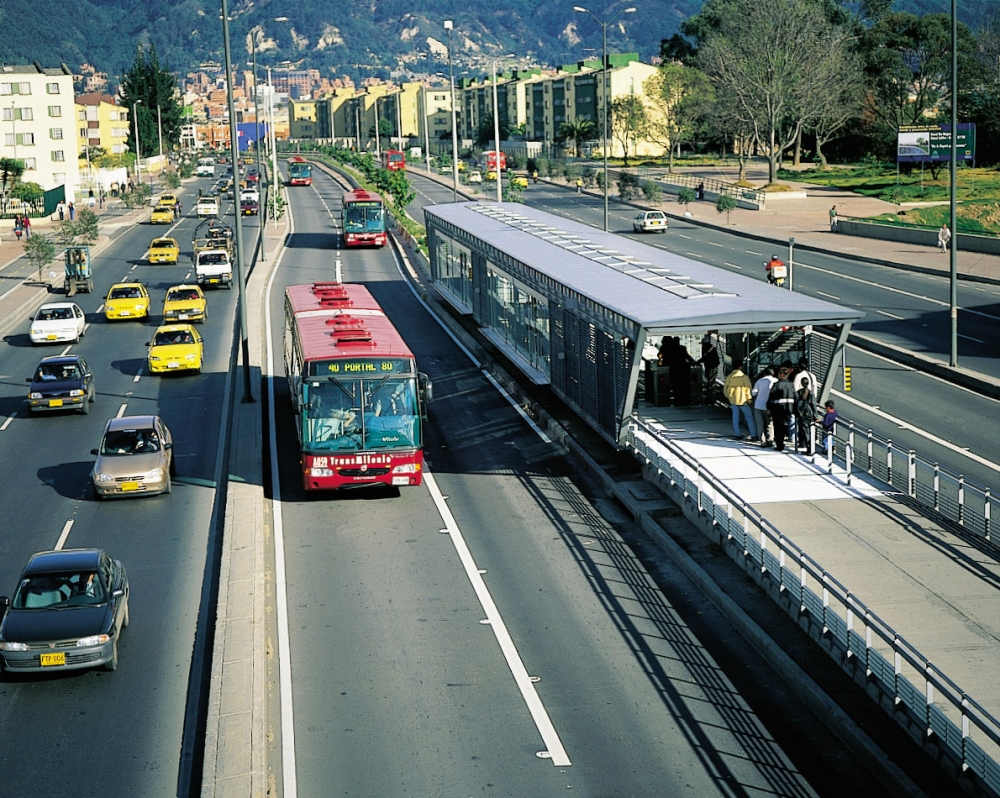 The crown jewel of Bogotáno transportation has to be the modern TransMilenio rapid transit system. In development since 2000, the system operates much like a train system on wheels with large articulated buses ferrying up to 160 passengers at a time between 116 elevated stations on nine lines - complete with express and local service. Special dedicated lanes, or troncales, were added to the middle of existing roads to accommodate the new system, presenting a low cost solution to this city's major congestion problem.
The experience goes something like this: Upon entering a station, passengers purchase smart cards loaded with fares for one or several trips on the system (1500 pesos per trip or about 65 cents.) After tapping your card to a sensor and passing through the turnstile, there are easy to read maps that outline the service provided at that station. Even for non-spanish speakers, the alpha-numeric route system is easy to decipher. Once you've determined what bus you need to take, overhead LED signs update you on the expected arrival time of your bus. Coming from Chicago, where communicating useful information to your paying customers is something that has not yet dawned on the transit authority, TransMilenio is an incredibly refreshing user-friendly system.
 The only problem TransMilenio is that it may be too good. About 1.3 million riders use the system each day and during rush hour you can expect buses on heavily used routes to be bursting at the seams. The crush of bodies is entirely bearable, however, when you realize you are whisking past gridlocked traffic at an incredible rate. Efficency has its price.
 Perhaps the most remarkable feature of the system is its cost. According to the Transportation Research Board of the U.S. National Academy of Sciences, the seven phases of TransMilenio development will eventually cost $3.3 billion (USD) and cover almost 400 km of roadway. This number is ten percent LESS than a proposed 30 km subway line. Clearly, the Bus Rapid Transit (BRT) model, of which TransMilenio is the largest in the world, is an excellent low-cost transportation option for rapidly developing cities on a tight budget.
Just keep your hand on your wallet...
Monday, December 1, 2008
World AIDS Day: HIV in Colombia
 December 1st is World AIDS Day. Those readers who know me are aware that before coming to Colombia I worked in HIV/AIDS advocacy in Chicago. Its an issue I am personally devoted to and hope to find a way to continue my involvement here in Bogotá.
In commemoration of the day, I thought I'd write up what I've learned so far about the epidemic here in Colombia. The World Health Organization (WHO) estimates that there are 170,000 living with HIV in Colombia. Of these, about 47,000 are women. This translates to a prevalence of about 0.6% in the general population.
Just as in the U.S., gay men and men who have sex with men bear the brunt of the epidemic. In 2002, the most recent year WHO numbers are available, an estimated 19.7% of men who have sex with men in major urban areas are living with HIV. Similar numbers across the globe recently led world leaders to declare at the 2008 International AIDS Conference in Mexico City that entrenched homophobia remains a primary obstacle towards truly effective HIV prevention programming for gay men.
Just as with gay men, the intersection of women and HIV in Colombia mirrors global trends. Lacking other economic opportunities, many women are forced into the sex industry where knowledge and use of protective measures, such as condoms, is far from universal. Furthermore, Colombia's decades-old internal conflict has led to countless instances of physical and sexual violence against women by the armed elements within the country. These factors combine to put many women, especially in rural areas and along the coast, at an increased risk of acquiring HIV.
One of the greatest success stories in the nearly 30 year battle against HIV/AIDS has been the development of highly effective means of preventing mother-to-child transmission of HIV. In Chicago, I was proud to work alongside the team that has all but eliminated instances of mother-to-child, or perinatal, transmission in the state of Illinois. Sadly, in Colombia these services are only available to an estimated 6% of HIV-positive mothers.
I have only begun to learn about the domestic HIV/AIDS situation here and my knowledge is indeed lacking. (For example, I have yet to learn anything about Colombia's injection-drug using population.) I hope to continue to uncover more and find a way to become actively involved in Colombia's fight against HIV/AIDS.
Sunday, November 30, 2008
Betancourt's Role and the Shortcomings of Gringo Media
 I'm going to depart from the facts for a little commentary on two points related to Friday's march...
First, why was Betancourt leading the rally from Madrid?
Betancourt is rightfully seen as a hero in this country. Her endurance and survival have made her a powerful symbol of strength in the face of the violent elements that have held this country hostage for so long.
Betancourt is French-Colombian and after her release she returned to France to recover and reconnect with her family. That sounds like an excellent and appropriate idea. In fact, I wouldn't blame her for never wanting to return to Colombian again. However, she is a strong leader and realizes that she is in a unique position to lead the public in resisting FARC and the other armed actors in Colombia.
If she weren't planning on returning to the country, then leading the rally in Madrid makes complete sense. The French and Spanish in particular have stood by the Colombians in denouncing FARC and they are strong international partners on this issue.
However, Ingrid came back on Saturday. Why not return a day earlier and lead the marchers here? This is where the conflict is and, while cultivating European support is a worthwhile endeavor, at the end of the day change must come from withing Colombia. This is where the work must be done.
I assume there are serious security concerns that would prevent Betancourt from making such an open public appearance in Colombia. Regardless, I think from an organizing standpoint, public knowledge that she is here and unable to safely appear in public is a much more powerful draw for people to join in the protests. At the risk of sounding too harsh, a rally in Madrid is effectively an empty gesture and more of a photo-op than a real political organizing strategy. But you do get to kick it with the Spanish foreign minister.
Anyway, this is only the beginning of her leadership on this issue and I trust she knows what's she doing much better than I. I look forward to watching and reporting on her work here.
Second point, English language media coverage of Friday's protests.
 Nearly all the English language coverage of the marches framed them as solely anti-FARC in nature. As someone who was here on the ground I have to say that this is a pretty egregious misrepresentation of reality. Now, I'm not a reporter nor am I an expert on the internal conflict here in Colombia, however any person who has decent eyesight and a basic understanding of Spanish could see that, while the majority of signage and slogans were anti-FARC, there was a very noticeable contingent of people protesting other guerilla groups, paramilitary groups, and ongoing human rights abuses by the Colombian military.
I'm told many people here use the term FARC to mean guerrillas in general and anti-FARC could be broadly understood to mean anti-guerrilla. However, focusing only on guerrillas means you are gravely oversimplifying the nature of this conflict. Framing the conflict in this way amounts to nothing less than poor journalism.
I think the best frame I've been exposed to is this: the conflict can be best characterized as armed actors (i.e. guerrillas, paramilitaries, and government security forces) assaulting the peace and human rights of the civilian population. In other words, its the guys with guns against everybody else. Who's 'side' the are on is largely irrelvant. All sides have been linked to hundreds of instances of murder, kidnapping, and other atrocities.
For some good background on the armed actors, check out this report by Amnesty International.
Saturday, November 29, 2008
Taking it to the Streets: 'Colombia Soy Yo'
 Yesterday, thousands of Colombians across this country and the globe took to the streets to protest the ongoing kidnapping, violence and other atrocities being committed by the armed elements of within the country. Clad in white t-shirts declaring 'Colombia Soy Yo' (I am Colombia), protesters most notably directed their ire towards Las Fuerzas Armadas Revolucionarias de Colombia (FARC) which holds an estimated 750 individuals in captivity.
However, its important to note that protesters also carried signs denouncing other guerrilla groups such as the Ejército de Liberación Nacional (ELN), paramilitary groups such as the Autodefensas Unidas de Colombia (AUC), and human rights abuses carried out by the National Army - reflecting the complex nature of the internal conflict.
In Bogotá, Carrera 7 was shut down for much of the afternoon as protesters march along its length. Many held photographs of family members who have been kidnapped or otherwise victimized in Colombia's decades-old internal conflict. This is the third march of this kind in 2008.
A rally in Madrid was led by former FARC captive and former Colombian presidential candidate Ingrid Betancourt, who was freed in a daring resuce operation several months ago. Word also came this morning that Betancourt will return to Colombia tonight for the first time since she was freed from capitivity.
Gringo media coverage:
BBC News
Associated Press
Ed. Note: This is the first mention I've made on Colombia's internal conflict. In the near future I will put together a post with a brief history and current status of the conflict.
Friday, November 28, 2008
Getting Around: Taxis
 If buses are the lead in the dangerous dance of Bogotáno traffic, their more graceful and agile partners are certainly the many tiny taxis jamming the streets. While the buses dominate the road way, the cabs are capable of weaving in and out of the way of their larger companions by utilizing some of the most spectacular death-defying maneuvers. These guys have to be some of the best drivers on Earth.
The cabs here are plentiful and, in my experience, relatively cheap. You can get halfway across the city for about ten thousand pesos (or a little less than $5 USD). Thanks to the numbered streets, its pretty easy to communicate where you want to go even if your Spanish, like mine, is poor.
Just like buses, the density of cabs makes them pretty easy to grab on any street corner. However, one of the nicest features of the cab companies here are their automated phone ordering systems. They have easy to remember phone numbers like 1-222222 or 1-444444. Even easier for the foreign visitor is the fact that you don't have to speak to anyone if you are calling from a land line. Just acknowledge you want a cab and they send it to the address associated with the phone number.
Once you climb into your cab and give the driver your destination, you'll notice one major difference from cabs in the U.S.: the size. Happily, the entire fleet of cabs in Bogotá (and cars in general - another post!) is made up of small, fuel-efficient vehicles. This is a big contrast from the full-size, gas guzzling Ford Crown Vics that are the standard in the U.S. While the extra leg room is nice, the recent rise in the price of gasoline has been devastating for cab drivers in Chicago and around the U.S. further driving up the cost of cabs via government imposed fuel surcharges. This is much less of an issue here.
Once the cab starts rolling down the calle, the thrill ride begins. I recommend not paying attention to some of the moves your driver will pull, ignorance is indeed bliss. In a city where the lanes painted on the road seemed to be considered wholly decorative, cab drivers are the masters of squeezing through any hole, cutting off any bus, and making turns onto any street from any lane (amazing!)
 After dark, red lights are optional and more often than not you'll find your driver disregarding them completely. I'm told this is legally sanctioned to help avoid robberies but it takes some getting used to.
Not only do drivers engage in this truly impressive behavior, but many of them embrace it. I've been in more than one cab that is suped up like a rally-car, complete with racing-style gauges and steering wheels. Incredible.
After my first few rides, I've left fear in my rear-view mirror and have come to really enjoy and respect the skills of these drivers.
Subscribe to:
Posts (Atom)