skip to main |
skip to sidebar
 Some human rights groups are not too happy about Bush awarding Colombian President Alvaro Uribe the United States highest civilian honor, the Medal of Freedom. Bush thinks Uribe's doin' a heckuva job fighting terrorists, that freedom hater Hugo Chavez, and those mean guys who made Bush do all that cocaine back at Yale (gratuitous Bush-bashing yes...but only eight days to go!)
Of course, to keen oberservers the integrity of the Medal of Freedom was long ago trounced upon by this administration. Look no further than fellow recipient George 'Slam Dunk' Tenet - former CIA director and key Iraq War intelligence fucker-upper.
Apologies for the slight deviation from the stated purpose of this blog...back to business.
Here's a good look at how Colombia's decentralized health care system impacts the provision of HIV/AIDS related care and treatment (thanks to Adriaan from Colombia Reports for sending this my way). Like many other places in the world, men who have sex with men and sex workers are among those at the highest risk for acquiring HIV in Colombia, however, the armed conflict shows its face in this arena too, with an increased prevalence among those who are displaced by violence.
 The L.A. Times sits down with the Colombian Minister of Defense, Juan Manuel Santos, to talk about the future of Plan Colombia under an Obama administration facing a trillion dollar budget deficit.
But really, I doubt Plan Colombia is going anywhere. What's a few hundred mil awash in a trillion dollar ocean? Cynical interpretation: its a small price to pay for one of the only Latin American-related talking points the Mesopotamian-minded U.S. foreign-policy universe can churn out these days. I think a lot of U.S. pols are less worried about the dubious merits of the program than having something to talk about other than Cuba or Hugo Chavez.
Here's hoping the Obama administration will become more engaged and shake things up a bit. We'll see.
View Larger MapLike many other cities, Bogotá almost completely shuts down and empties out near the end of the calendar year. Business comes to a stand still and many people travel to spend the holidays with their families in other parts of the country. Not wanting to miss out on this experience, I was thrilled to be invited to spend a few weeks with my girlfriend's family in Bucaramanga, capital of the department of Santander, about 200 miles north of Bogotá.
Now getting from Bogotá to Bucaramanga isn't exactly like driving from Chicago to Indianapolis. Those accustomed to the high-speed effiency of the Eisnehower Interstate System of the U.S. may find the road system here a bit, shall we say, challenging. All told, it takes about 8 hours of winding your way down through the Andes to reach Bucaramanga from Bogotá. I took an overnight bus, which means trying to sleep while the hyper-aggressive operators try to take the corners like an Indycar driver. It was a surreal experience and I felt like someone who was sleep deprvied after hours of interrogation, ready to confess to anything. However, for $30 you really can't beat it.
 The insanity started to melt away as the sun began to rise and I got my first look at Chicamocha Canyon, a spectacular natural wonder that must be traversed in order to reach Bucaramanga from the South. Arriving at the bottom of the canyon, you slowly start to wind your way back up towards the city - about an hour further down the road. Here is where I first noticed the big change in altitude from Bogotá as evidenced by the more lush, tropical flora. Bucaramanga is about a 1700 meter drop from the capital city - resting just below 1000 meters (about 3,100 feet in gringo reckoning).
 La Ciudad Bonita (the Pretty City), Bucaramanga is home to about 600,000 people, with four adjoining municipalities bringing the total metro population to around one million residents. This makes it the seventh largest metro area in the country but about the fifth most important economically. Despite dramatic growth in the second half of the 20th century, the city maintains the laid back atmosphere of a small town with people stopping to chat with friends on the quiet streets. It was a real breath of fresh air from the chaotic Bogotáno lifestyle.
And indeed, the air is fresher. The lower alititude makes particulate matter from desiel enginges much less of an issue. What is more, the weather is simply stunning. An average temperature of 23 degrees Celsius (73 Farhenheit) with moderate humidity and plenty of sunshine in December made my visit extremely plesant. Also known as the 'City of Parks,' Bucaramanga is very walkable with a bustling commercial center full of shops and restaurants.
Just super.
 A very happy new year to one and all! I apologize for the lack of notice regarding my holiday hiatus, however, its a new year and I resolve never to leave the readers of Gringo in Colombia hanging again.
Can we still be friends?
Good, because we have a lot to catch up on. During my month absence I had the opportunity to experience the holiday season Colombian-style, travel to other parts of the country, each all sorts of weird things, and survive some kind of crazy jungle virus. I'm going to try and cover all of this and more in the next few days before pressing onward into 2009.
To the future!
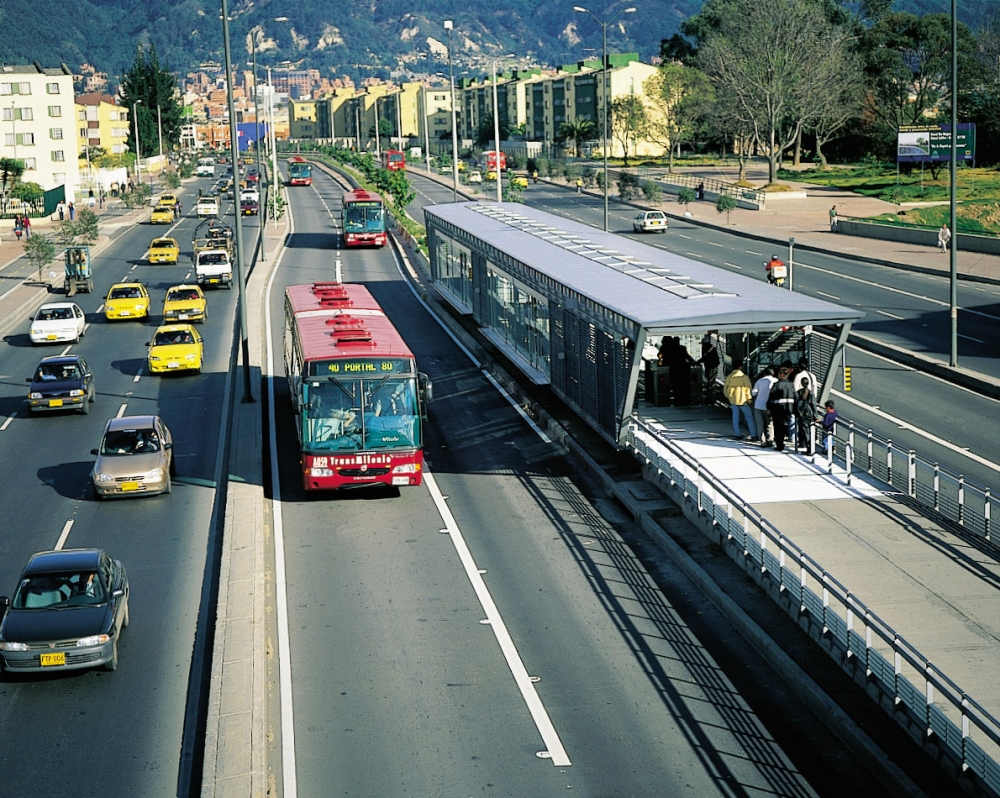
 The crown jewel of Bogotáno transportation has to be the modern TransMilenio rapid transit system. In development since 2000, the system operates much like a train system on wheels with large articulated buses ferrying up to 160 passengers at a time between 116 elevated stations on nine lines - complete with express and local service. Special dedicated lanes, or troncales, were added to the middle of existing roads to accommodate the new system, presenting a low cost solution to this city's major congestion problem.
The experience goes something like this: Upon entering a station, passengers purchase smart cards loaded with fares for one or several trips on the system (1500 pesos per trip or about 65 cents.) After tapping your card to a sensor and passing through the turnstile, there are easy to read maps that outline the service provided at that station. Even for non-spanish speakers, the alpha-numeric route system is easy to decipher. Once you've determined what bus you need to take, overhead LED signs update you on the expected arrival time of your bus. Coming from Chicago, where communicating useful information to your paying customers is something that has not yet dawned on the transit authority, TransMilenio is an incredibly refreshing user-friendly system.
 The only problem TransMilenio is that it may be too good. About 1.3 million riders use the system each day and during rush hour you can expect buses on heavily used routes to be bursting at the seams. The crush of bodies is entirely bearable, however, when you realize you are whisking past gridlocked traffic at an incredible rate. Efficency has its price.
Perhaps the most remarkable feature of the system is its cost. According to the Transportation Research Board of the U.S. National Academy of Sciences, the seven phases of TransMilenio development will eventually cost $3.3 billion (USD) and cover almost 400 km of roadway. This number is ten percent LESS than a proposed 30 km subway line. Clearly, the Bus Rapid Transit (BRT) model, of which TransMilenio is the largest in the world, is an excellent low-cost transportation option for rapidly developing cities on a tight budget.
Just keep your hand on your wallet...
 December 1st is World AIDS Day. Those readers who know me are aware that before coming to Colombia I worked in HIV/AIDS advocacy in Chicago. Its an issue I am personally devoted to and hope to find a way to continue my involvement here in Bogotá.
In commemoration of the day, I thought I'd write up what I've learned so far about the epidemic here in Colombia. The World Health Organization (WHO) estimates that there are 170,000 living with HIV in Colombia. Of these, about 47,000 are women. This translates to a prevalence of about 0.6% in the general population.
Just as in the U.S., gay men and men who have sex with men bear the brunt of the epidemic. In 2002, the most recent year WHO numbers are available, an estimated 19.7% of men who have sex with men in major urban areas are living with HIV. Similar numbers across the globe recently led world leaders to declare at the 2008 International AIDS Conference in Mexico City that entrenched homophobia remains a primary obstacle towards truly effective HIV prevention programming for gay men.
Just as with gay men, the intersection of women and HIV in Colombia mirrors global trends. Lacking other economic opportunities, many women are forced into the sex industry where knowledge and use of protective measures, such as condoms, is far from universal. Furthermore, Colombia's decades-old internal conflict has led to countless instances of physical and sexual violence against women by the armed elements within the country. These factors combine to put many women, especially in rural areas and along the coast, at an increased risk of acquiring HIV.
One of the greatest success stories in the nearly 30 year battle against HIV/AIDS has been the development of highly effective means of preventing mother-to-child transmission of HIV. In Chicago, I was proud to work alongside the team that has all but eliminated instances of mother-to-child, or perinatal, transmission in the state of Illinois. Sadly, in Colombia these services are only available to an estimated 6% of HIV-positive mothers.
I have only begun to learn about the domestic HIV/AIDS situation here and my knowledge is indeed lacking. (For example, I have yet to learn anything about Colombia's injection-drug using population.) I hope to continue to uncover more and find a way to become actively involved in Colombia's fight against HIV/AIDS.
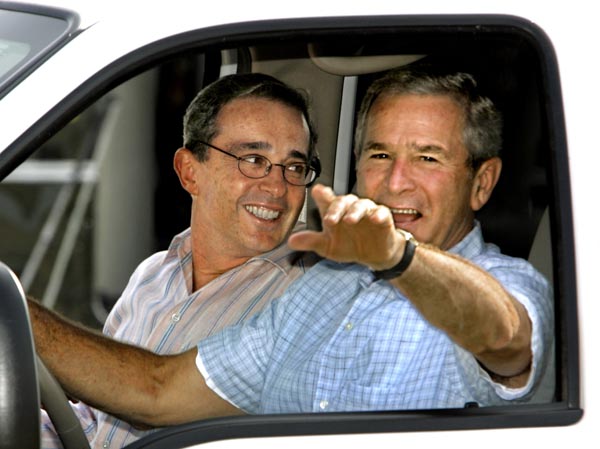 Some human rights groups are not too happy about Bush awarding Colombian President Alvaro Uribe the United States highest civilian honor, the Medal of Freedom. Bush thinks Uribe's doin' a heckuva job fighting terrorists, that freedom hater Hugo Chavez, and those mean guys who made Bush do all that cocaine back at Yale (gratuitous Bush-bashing yes...but only eight days to go!)